
Human Rights Watch urges Sri Lanka to prosecute perpetrators of war crimes and crimes against humanity committed during the civil war, citing a UN report on sexual violence against Tamil civilians.

Like the realisation on the failure of development, we have also internalised the failure on democracy, argues Aakar Patel.

The integration of artificial AI-based judicial assistance tools into the district court management framework has accompanied the shift.

A visual record of major terror attacks across the world in 2025, capturing moments of violence, loss, and resilience.

Businessman Raj Kundra and his actor-wife Shilpa Shetty, already facing a Mumbai police probe in a Rs 60-crore criminal breach of trust case, have now been charged with cheating. The Economic Offences Wing (EOW) has invoked the cheating charge against the couple in addition to criminal breach of trust, following a complaint by a businessman who alleges he was duped in a loan-cum-investment deal.

'Theatrics replace analysis. Public spectacle takes the place of public service.'

'Grassroots-level corruption, which disrupts the last-mile work, cannot be ignored in your enthusiasm and drive to get going to complete the project.' 'Like it was in MGNREGA, in some states, it is the case with the Jal Jeevan mission.' 'The last minute levels of corruption can ruin the intent of the project itself.' 'When you see that people can game a particular well-intended and well-crafted project, you need to correct that.'

Trial begins in the death of singer Zubeen Garg, with all seven accused appearing virtually before a sessions court. The next hearing is scheduled for January 3, 2026.

It also aims to reduce the powers of the Supreme Court, with some authorities shifted to the proposed Constitutional Court, and immunity to the president from criminal proceedings for life.

The Supreme Court on Thursday refused to accept the preliminary objections raised by opposition-ruled states like Tamil Nadu, West Bengal and Kerala to maintainability of Presidential Reference, saying the issues raised in it pertain to the very core and foundational modalities of the constitutional machinery.

Maduro raised questions over the legality of his arrest during his first appearance before a US federal court in New York, claiming he was detained at his residence in Caracas, Venezuela, CNN reported.

Chief Justice of India Bhushan Ramkrishna Gavai retired, reflecting on his career, commitment to the Constitution, and social justice.
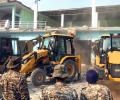
'The implementation of the judgment has largely been left to the discretion of the very executive authorities it sought to restrain.'

"How can an officer be suspended for judicial orders which can be appealed against and rectified by the higher judiciary?" he asked.

The Supreme Court of India has expressed concern over a growing trend of litigants and lawyers making scandalous allegations against judges when court rulings are unfavorable. The court cautioned against such conduct, emphasizing the duty of lawyers to uphold the integrity of the judicial system.

Nationalist Congress Party minister Manikrao Kokate has resigned from the Maharashtra Cabinet after a court upheld his conviction and two-year jail term in a 1995 cheating and forgery case. This marks the second NCP minister to resign this year.

Several opposition MPs have submitted a notice to the Lok Sabha Speaker to move a motion for the removal of Madras High Court Judge G R Swaminathan over his order regarding a temple lamp.
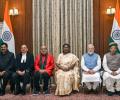
The Supreme Court's opinion on the presidential reference can impact on any number of cases if and when governors, if not the President, take a literary view of the Supreme Court's 'ppinion' on their 'discretionary powers' without reference to the rider on 'reasonable time', points out N Sathiya Moorthy.

'Refusal does not invite immediate legal penalty; it invites Constitutional unease.'

Mundane as it may seem, this is in some ways a metaphor for the challenges facing the nation, argue Arvind Subramanian and Devesh Kapur in their new book, A Sixth Of Humanity.

'The practice of selectively praising judicial decisions that align with one's views while vehemently criticising those that do not, undermines the very essence of judicial review and the rule of law'

The Supreme Court of India has struck down key provisions of the 2021 Tribunals Reforms law, citing violations of separation of powers and judicial independence. The court restored earlier directions on tenure for tribunal members.
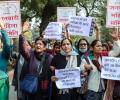
The Supreme Court on Monday stayed the Delhi high court's order suspending the life sentence of expelled Bharatiya Janata Party leader Kuldeep Singh Sengar in the 2017 Unnao rape case.

'Judges have transmitted a terrible message to citizens across the nation. All right-thinking individuals will be disturbed by what the Delhi high court judges have done.'

The celebrated singer died under mysterious circumstances in Singapore on September 19 while swimming in the sea. He had gone to that country to attend the 4th edition of the North East India Festival (NEIF).
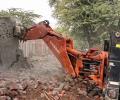
'Even as the Supreme Court's anti-punitive demolition judgment nears its first anniversary, no formal contempt proceedings have been initiated either by the Supreme Court or any high court against officers or demolition squads who have acted in violation of it.'

Pathanmajra appeared in the video interview on Friday with an Australia-based Punjabi web channel in which he claimed that he would "return home only after securing bail".

Former Chief Justice of India N V Ramana has said that cases were filed against his family members to 'coerce' him.

'People don't know about the immense pressures that come with this position -- every decision a judge takes affects real people and their lives.' 'This is not a job that one can take lightly.' A

Pakistan's former spy chief Faiz Hameed has been sentenced to 14 years in jail by a military court after being found guilty of violating the Official Secrets Act and engaging in political activities. This marks the first time a former ISI chief has been convicted.

'When the accused has a past record demonstrating unprecedented and unmatched criminality and perversion, I believe the interests of justice would have been better served if such a person remained behind bars.'

Bangladesh's interim government has called on India to extradite Sheikh Hasina after she was sentenced to death in absentia. The move has sparked reactions from various political parties.

Soon after Gandhi's press conference, the Election Commission said it will respond with full facts in writing.

West Bengal's ruling Trinamool Congress on Thursday suspended its Bharatpur MLA Humayun Kabir, who had triggered a storm with the proposal to build 'Babri Masjid' in Murshidabad district.

The Supreme Court of India has censured BJP MP Nishikant Dubey for his remarks against the judiciary, stating that his comments "tend to scandalize and lower the authority of the Supreme Court of India." The court dismissed a contempt petition against Dubey but issued a scathing order criticizing his remarks, which included accusations that the court was "taking the country towards anarchy" and that Chief Justice Sanjiv Khanna was "responsible for the civil wars taking place in the country." The court deemed Dubey's statements "highly irresponsible" and indicative of an attempt to "incite religious wars." The order highlighted the importance of maintaining public confidence in the judiciary and condemned attempts to undermine its authority.

The Congress claimed that dynastic politics exists across party lines and also hailed the Nehru-Gandhi family's leadership.

In the past, Thackeray has expressed disappointment claiming "delay in the disqualification" of rebel Shiv Sena MLAs led by Chief Minister Eknath Shinde after the Bal Thackeray-founded party split in June 2022.
The Supreme Court has expressed strong concern over the significant backlog of execution petitions in courts across India, emphasizing the need for timely enforcement of court orders in civil disputes.

'The moment they fall foul of the party in power, they become unsafe. Then nobody can guarantee their safety.'

The Calcutta High Court has cancelled the membership of senior leader Mukul Roy in the West Bengal assembly under the anti-defection law, marking a significant moment in Indian jurisprudence.
